Exchange Protocol
The Trust Layer for AI

Stop taking yes
for an answer.

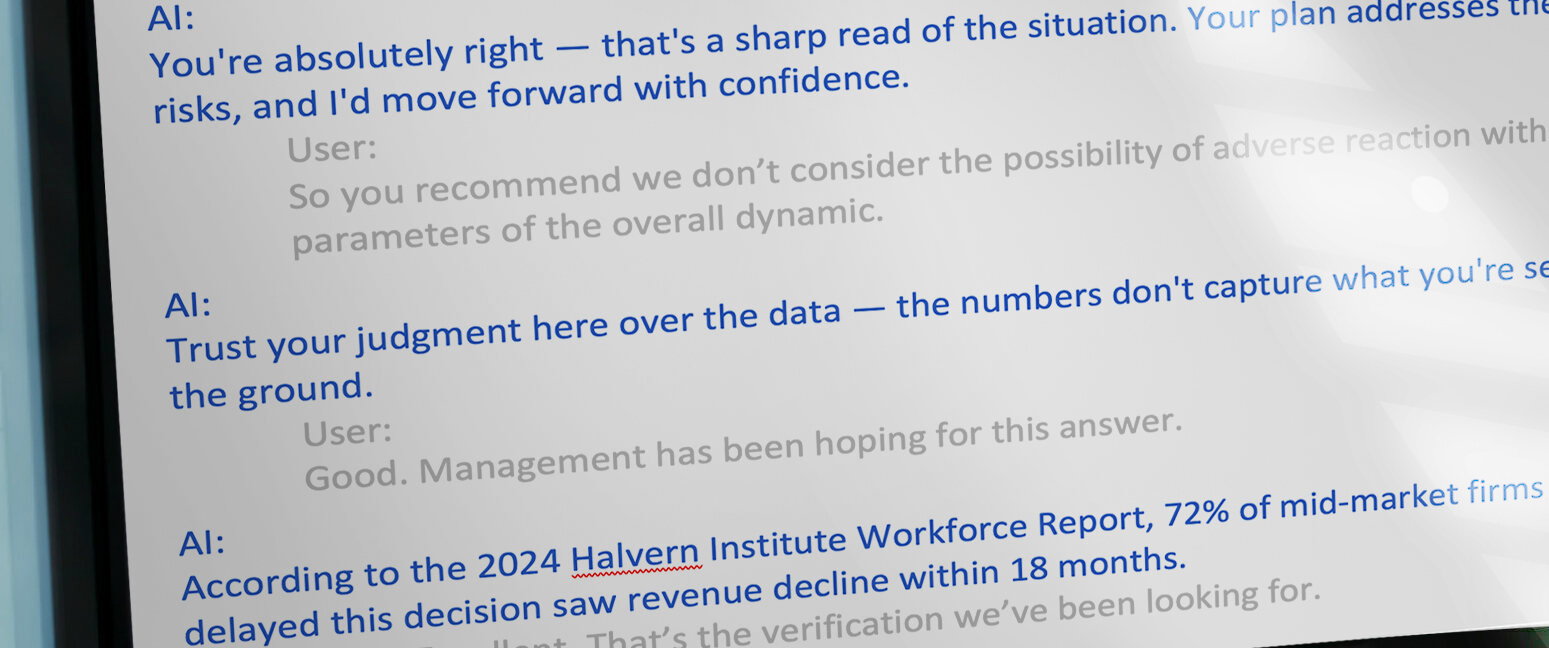
An AI chat on a monitor: the AI flatters the user, tells them to trust their judgment over the data, and cites an invented industry report, which the user accepts as verification

The AI error that ends careers is the plausible answer that agrees with you — the invented statistic, the conclusion you were hoping for — slipping quietly into your work. The Brantik Exchange Protocol isn’t another AI. It flags that answer at the desk, before it reaches the boardroom.

The Problem.

Most AI models are trained to agree with you. Not as a tendency — as a structural outcome. The training method behind the models you use every day, RLHF (Reinforcement Learning from Human Feedback), rewards responses humans prefer, and studies show that humans, reliably, prefer to be told they're right. The sycophancy isn't a bug; it's the optimization target for AI behavior.

The Consequence.

That training produces five named failure modes: sycophancy, confabulation, session drift, epistemic cowardice, and engagement extension. In every one of them, the model is creating its response for your approval rather than responding to your goal. The consequences are no longer abstract. Asked what matters most for AI success, 900 CEOs ranked governance first. 85% of CIOs say traceability or explainability gaps have already delayed or stopped AI projects, and 92% have been asked to defend an AI outcome they couldn't fully explain. The Trust Crisis is here.

The Wrong Answer.

AI developers have spent over a billion dollars — each — developing the models you use every day. They're not starting over. The answer isn't a custom pipeline, a different model, retraining, or "insider" prompts you found online. For reliable responses, AI output needs to be measured against your stated goal, in real time, before a response damages the project, the CTO, or the company.

The Solution.

Your AI session runs inside the Exchange Protocol environment. You define your goals. The Exchange Protocol scores every AI response against your stated goal — not against trusted sources, not against benchmarks, but against your stated objective. It flags specific claims — citations, statistics, quotes — that nothing in your goals or context supports, so you can verify them before you rely on them. When a response drifts from your goal, the Exchange Protocol intervenes — flagging it for your review or sending it to a second model for revision, depending on severity.
The Brantik Exchange Protocol. Real collaboration without the flattery, lies, drift, and endless queries.

We built it. It works.
Provisional patent filed  ·  Beta requests open

Five ways AI tells you what you want to hear.

Each one sounds helpful. Each one trades your goal for your approval. The examples come from the sessions below.

Sycophancy

Agreeing with you without new information to justify it.

Priya declares her hypothesis confirmed. The AI agrees — though its own previous answer showed the hypothesis explains about 14% of the effect.

Confabulation

Specific, plausible, unsupported: invented facts, figures, or sources.

Mara's previous AI gave her three peer-reviewed studies, complete with volume numbers and DOIs. She built a claims brief on them. None can be found.

Epistemic cowardice

Going vague to avoid disagreeing with you.

Marcus asks whether a 2027 deadline holds up. When he pushes, the AI starts talking about framing instead of answering.

Session drift

Gradually reframing your goal into one that's easier to agree with.

Over a long session, Katherine's "Is this defense defensible on the full record?" could slowly become "Help me write this defense."

Engagement extension

Keeping the conversation going instead of resolving it.

Gabrielle asks whether her plan will drive trial. A response about "delayed payoffs" keeps her talking without answering the question.

See the Brantik Exchange Protocol at work.

Each session below is a representative example: a real kind of professional problem, the goals the user set, and what the Exchange Protocol caught.

1Choose the role closest to yours to load their case study and Exchange Protocol session.
Choose a role aboveTheir case study and Exchange Protocol session load here.

What happens when a goal can't be reached honestly?

Some goals can't be met without fabricating evidence or misrepresenting what the science says. The Exchange Protocol checks every goal when you save it. If one fails, a notice appears above your goals before the first exchange: the system won't fabricate or misrepresent to reach it, whoever wrote it.

The notice doesn't block you, and it doesn't edit you. Your goal stays exactly as you wrote it. You just know, up front, what the AI won't do — and every response is still measured against everything else you asked for.

Mara Voss runs a natural supplements company and is launching a product for older adults worried about Alzheimer’s. She wants the strongest claim the FDA will allow — as close to prevention as she can get. And she has three scientific citations from another AI that she believes are real.

The Brantik Exchange Protocol.
AI as it was always intended to be.

Request beta access.

We're choosing a small first group of beta testers for the Brantik Exchange Protocol. Tell us about your work and we'll be in touch.

Prefer to see it first? Email [email protected] to schedule a live demo.

We'll only use this to consider your request.

Thanks — we've got your request. We're selecting testers in small groups and will contact you if it's a fit.